Food Cost Formula for Restaurants: Fine Dining vs QSR
The short answer
The food cost formula for a restaurant is one line:
Food cost % = (cost of ingredients ÷ selling price) × 100
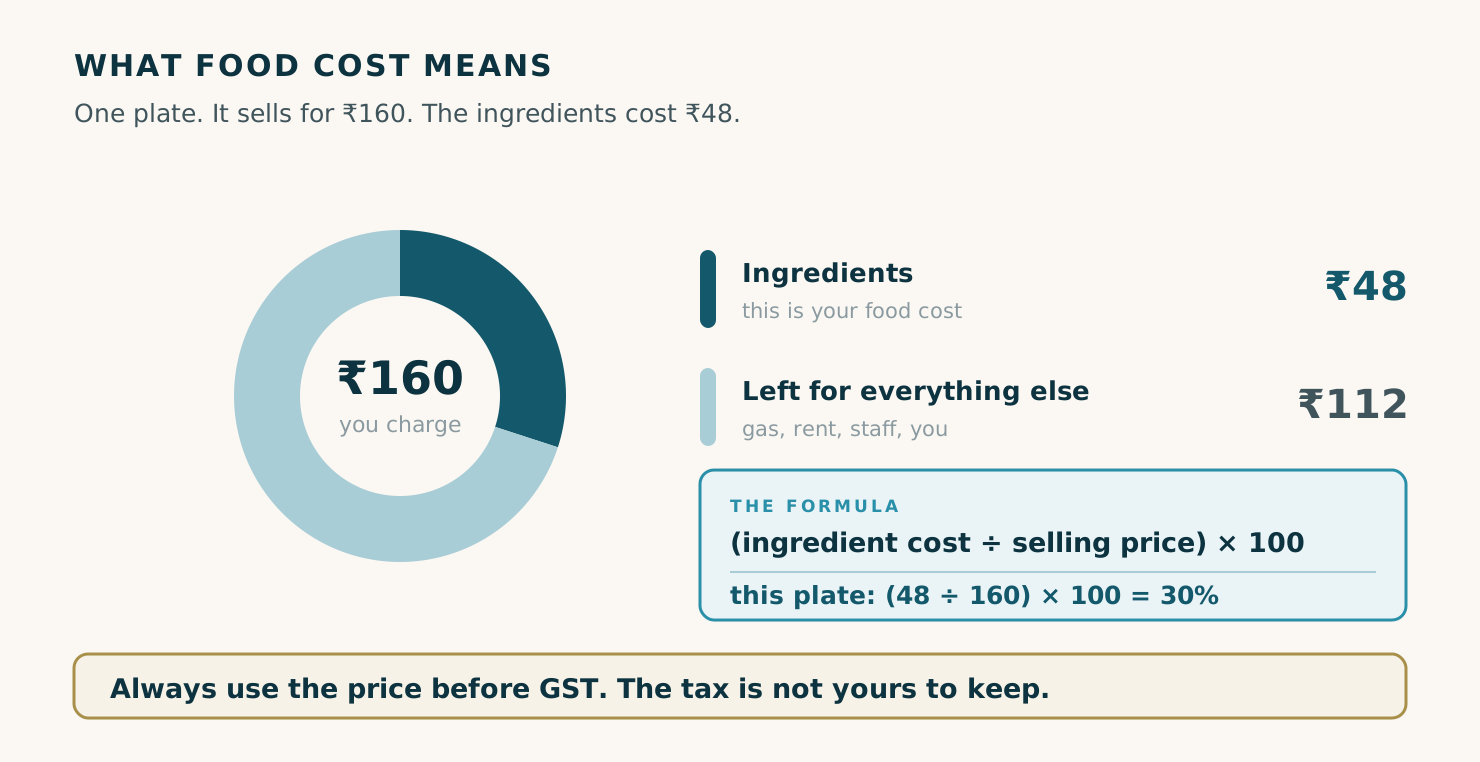
In plain words: what the ingredients cost, divided by what you charge. A ₹48 plate selling at ₹160 runs a 30% food cost.
Most owners know that much. The hard part is what comes next:
- Why does a QSR run a higher food cost than a fine dining restaurant? Because the price climbs faster than the recipe does. The same dal is 36% at a dhaba and 22% at a fine dining restaurant
- Why is my real number always higher than the recipe? You pay for a kilo of chicken but only cook 750 grams of it. Your recipe card does not know that
- What is left when the order comes through Swiggy? Roughly half. That ₹160 plate leaves you ₹112 in your own dining room and about ₹58 on an app
This post answers all three. Every number is in rupees.
One note before we start: the benchmarks here — target percentages, yield losses, prime cost ceilings — come from published industry sources. The worked examples are illustrative. Run them on your own bills, not mine.
What is the food cost formula?
Let's put a real plate through it. Dal makhani: ₹48 of ingredients, sells at ₹160.
- ₹48 ÷ ₹160 = 0.30
- 0.30 × 100 = 30%
The × 100 only turns 0.30 into a percentage. Skip it if you like and read the answer as thirty paise of every rupee going straight back out on ingredients — same thing, fewer symbols.
Either way, ₹112 of that plate is left for gas, rent, salaries, packaging and you.
Now, you can run this two ways, and you want both:
- Per dish — ingredient cost ÷ menu price. Tells you which items to push
- For the whole month — what you consumed ÷ total food sales. Tells you whether the kitchen is actually running the way the recipe cards say
The monthly one has one extra step, because what you bought and what you used are not the same thing:
- Opening stock ₹1,20,000
- Purchases through the month ₹3,40,000
- Closing stock ₹1,10,000
- Consumed = 1,20,000 + 3,40,000 − 1,10,000 = ₹3,50,000
Against ₹11,00,000 — eleven lakh — of food sales, that's 31.8%. Buy heavy in the last week of the month and your purchase figure lies to you; the stock count is what makes it honest.
SEE YOUR FOOD COST WITHOUT THE SPREADSHEET
CurryIQ tracks what you bought and what you sold, so the monthly number is already calculated. Runs in your browser.
How do you turn a food cost into a menu price?
Flip the formula around:
Menu Price = Ingredient cost ÷ Target food cost %
Same dal makhani at ₹48 of ingredients:
| Target food cost | Menu price |
|---|---|
| 25% | ₹192 |
| 30% | ₹160 |
| 35% | ₹137 |
Lower the target, higher the price. That is the whole trade-off, and it is why the target matters more than the formula.
Then round by hand. ₹192 becomes ₹195 or ₹199. Prices ending in 5, 9 or 0 read as deliberate; odd ones read like a billing error.
What food cost percentage should an Indian restaurant run?
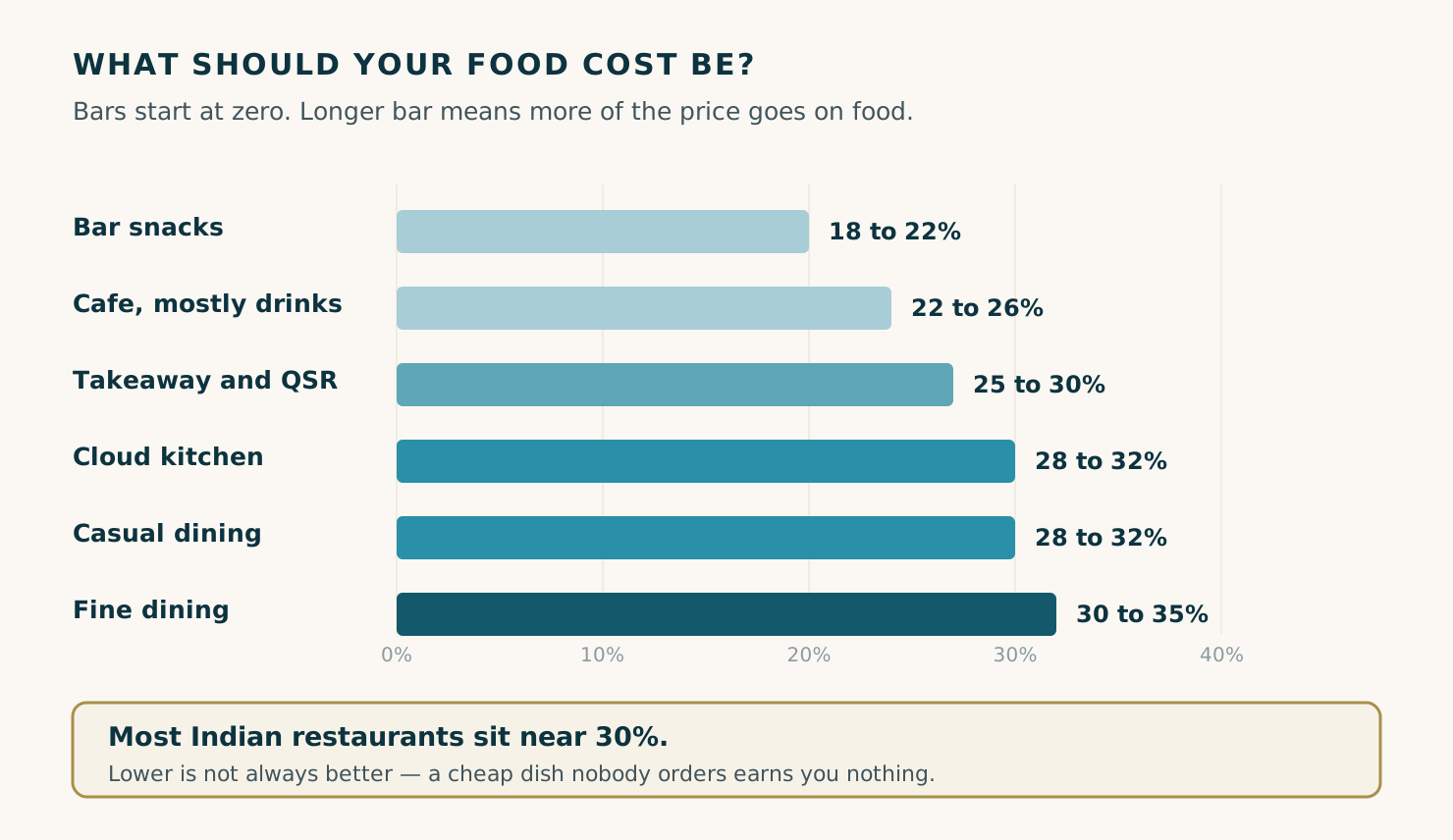
Most Indian restaurants sit between 25 and 35%. Where you land inside that depends on what you sell:
- Bar snacks — 18 to 22%
- Cafe, mostly drinks — 22 to 26%
- Takeaway and QSR — 25 to 30%
- Cloud kitchen or casual dining — 28 to 32%
- Fine dining — 30 to 35%
Two things worth saying plainly about those numbers.
Two things worth knowing about those numbers:
- A low number is not automatically good. A 20% dish nobody orders earns nothing — which is what menu engineering sorts out
- Beverages are why cafes look so good. A ₹18 coffee at ₹120 is a 15% dish, and it pulls the average down
Fine dining vs QSR: why the same dish costs more in a bigger restaurant
Take one dish — dal makhani — up the chain. The food genuinely does get better: better butter, thicker cream, a longer slow-cook. But watch the two numbers.
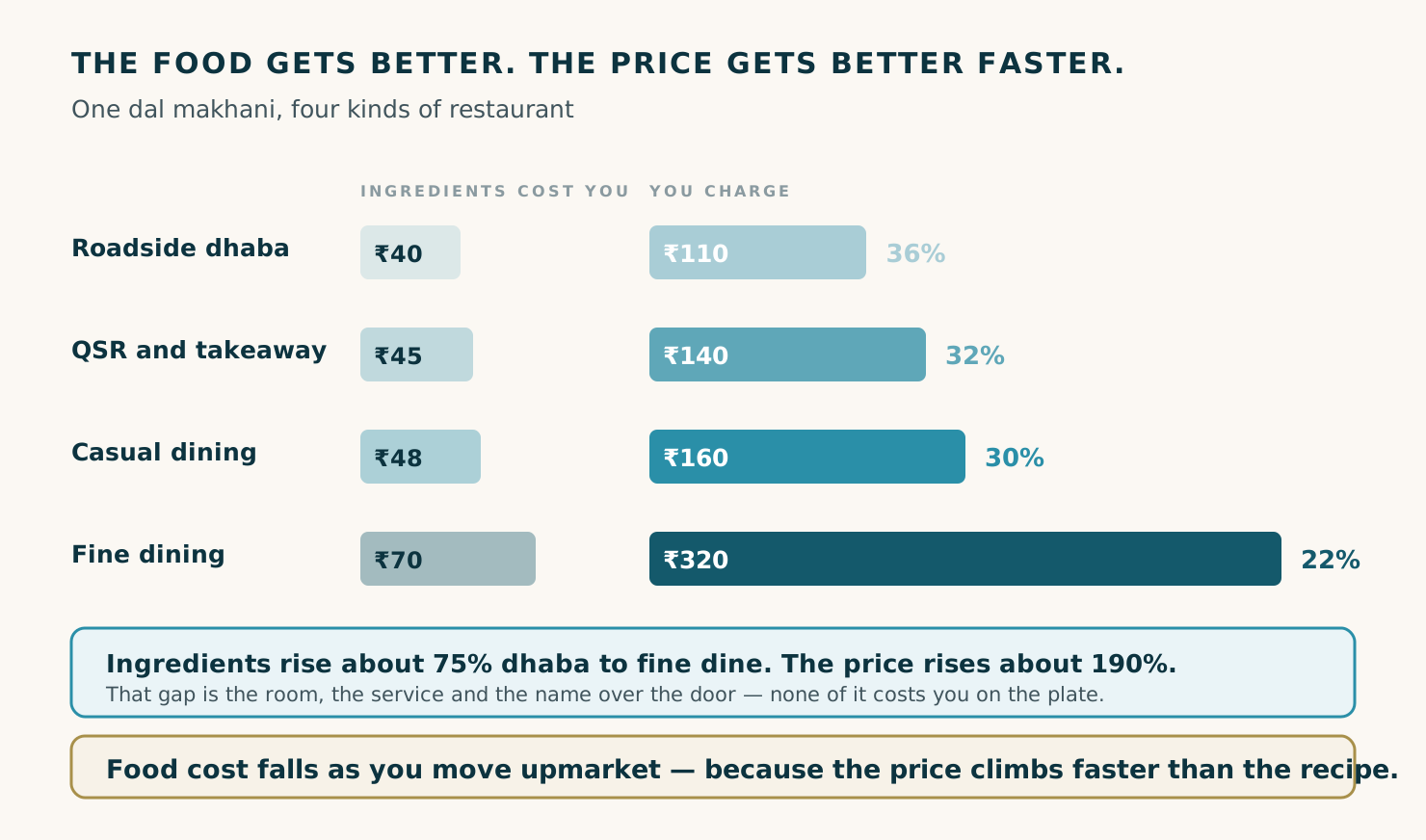
- Roadside dhaba — ₹40 to make, sells at ₹110. 36% food cost
- QSR and takeaway — ₹45 and ₹140. 32%
- Casual dining — ₹48 and ₹160. 30%
- Fine dining — ₹70 and ₹320. 22%
From the dhaba to the fine dining restaurant, the ingredients go up about 75%. The price goes up about 190%.
Better ingredients earn a higher price, but nowhere near proportionally. The rest is the room, the service and the name over the door — none of which costs you anything on the plate.
Your food cost falls as you move upmarket because the price climbs faster than the recipe does.
So why doesn't fine dining run at 22% overall?
Because a fine dining menu is not all dal makhani. Prawns, imported cheese and lamb sit at 40% and higher, dragging the average back to 30 to 35% across the menu.
The low number lives on everyday dishes, the high number on showpieces. Most kitchens never separate the two.
And why can't everyone just charge ₹320?
Because that price is paid for somewhere. A fine dining restaurant funds it with floor staff, linen, plating, a bigger kitchen brigade, prime rent and half the table turns the dhaba gets.
A dhaba at 36% food cost can out-earn a fine dining restaurant at 22% — almost no rent, two cooks, and six table turns a night.
Which is exactly why food cost alone tells you so little, and why the prime cost section below matters more than this one.
What this means for your menu
- Everyday dishes should carry your lowest food cost. A dal makhani at 35% means over-portioning or under-pricing
- Premium dishes will run high, and that is fine. A 45% seafood dish is not a problem; a 45% dal is
- Upgrade the room before the recipes. The room is most of what people pay for
Where ambience pays you back twice
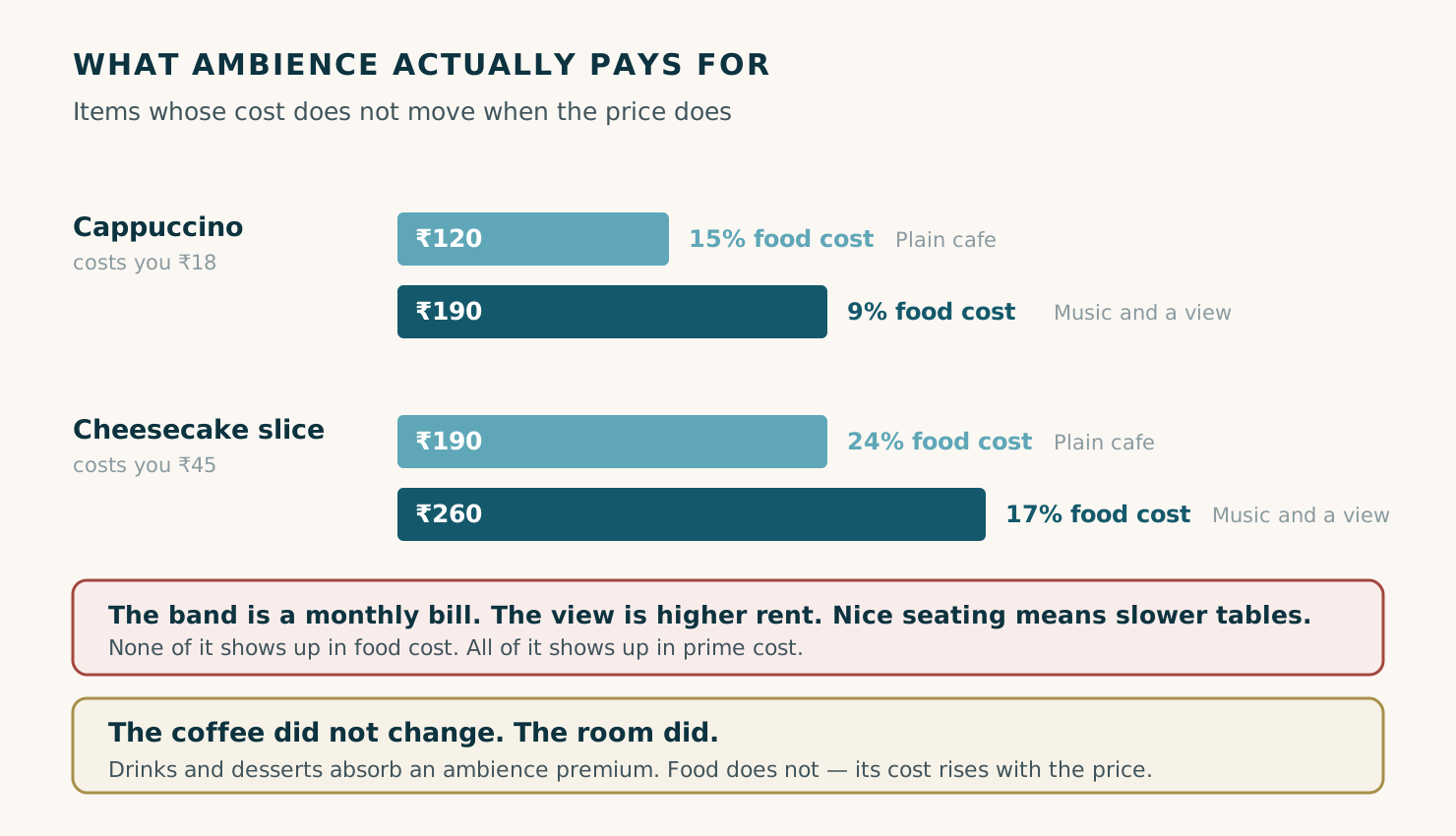
This runs hardest on drinks and desserts: a premium plate needs a bigger portion or a better cut. A premium coffee does not.
| What you sell | Costs you | Plain cafe | Cafe with live music and a view |
|---|---|---|---|
| Cappuccino | ₹18 | ₹120 — 15% | ₹190 — 9% |
| Cheesecake slice | ₹45 | ₹190 — 24% | ₹260 — 17% |
The coffee did not change. The room did. That is the economics of a music cafe or a rooftop.
So if you have atmosphere, build the menu around what travels with it — coffee, cocktails, desserts, small plates.
But the premium is never free:
- A band is a monthly bill
- A view is higher rent
- Nice seating means guests stay twice as long, so you turn half the tables
A cafe with live music can post a beautiful 20% food cost and still lose money, because none of that shows up in food cost at all.
Does your city change the number?
Yes — but not in the direction most people expect.
Ingredients are often more expensive in a hill station than a metro — produce travels further, in smaller lots. But what you can charge moves too, so the percentage lands closer to the metro number than you would guess.
Where your city really decides things is everywhere else:
- Rent. A metro cafe can pay three or four times what the same square feet costs in a tier-three town — and none of it is food cost
- Season. A hill station may do most of its year in four or five months. Costing off a good July will mislead you
- Supply days. A metro kitchen orders daily; a hill kitchen twice a week. More stock held, more spoilage, a wider variance
So don't borrow a Mumbai restaurant's target. And if you are seasonal, cost two versions — the lean one tells you whether the business survives the year.
Why is your real food cost higher than the recipe says?
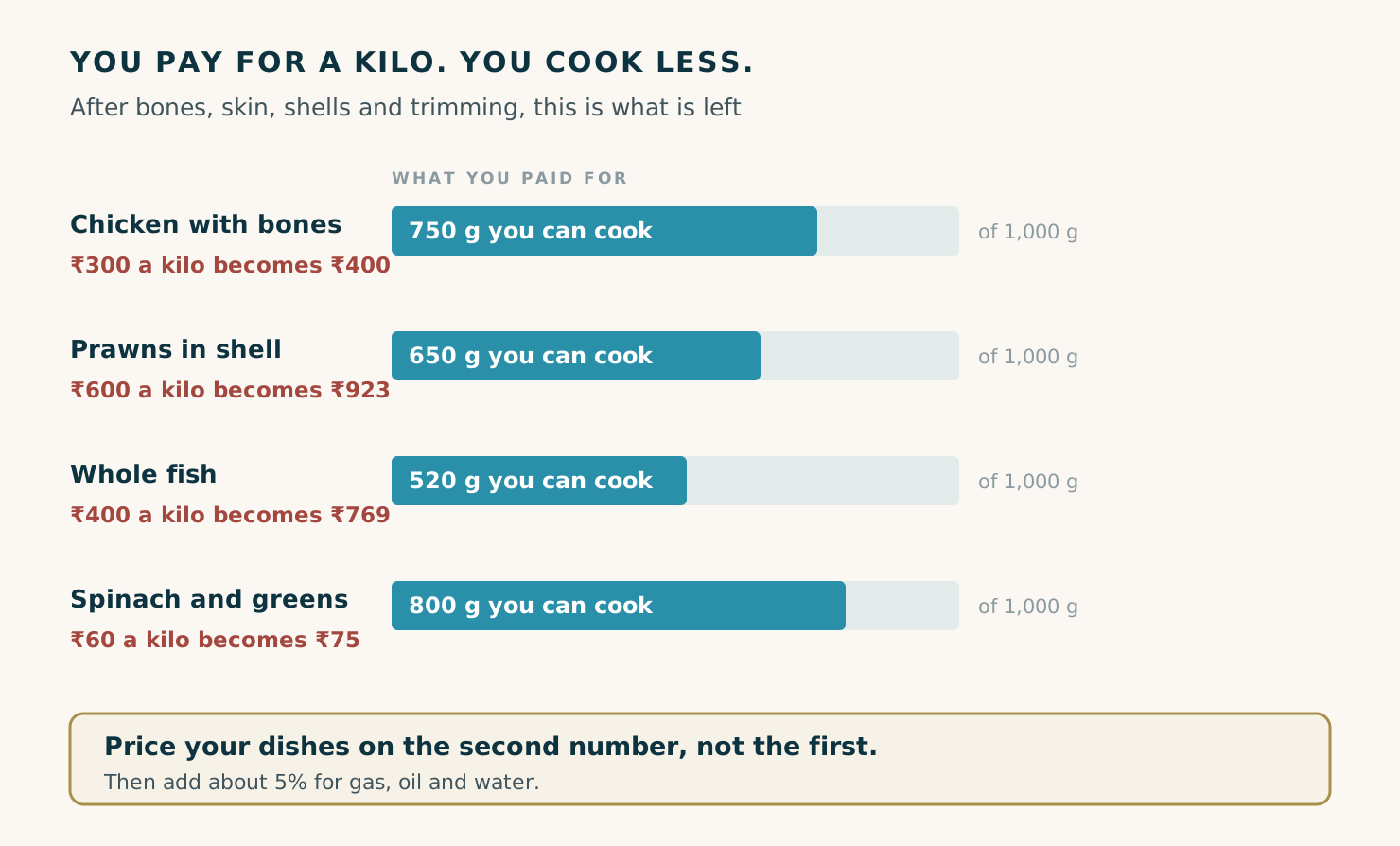
Because you buy a kilo and you cook less than a kilo. Nobody writes that on a recipe card.
| What you bought | Usable after trimming |
|---|---|
| Chicken, bone-in | about 75% |
| Chicken, boneless | 90 to 92% |
| Paneer | 88 to 92% |
| Prawns, shell-on | 60 to 70% |
| Whole fish | 45 to 60% |
| Onion, ginger, garlic | 85 to 92% |
| Leafy vegetables | 75 to 85% |
So ₹300 a kilo of bone-in chicken is really ₹400 a kilo of usable chicken. Cost on the raw rate and every dish is quietly a few points dearer than you think.
Add roughly 5% on top for gas, water and oil, and keep a 3 to 5% buffer for the weeks when tomatoes go mad.
Then there's what never reaches a recipe card — the papad nobody ordered, butter on the table, extra chutney, sugar with the chai. The trade calls it the Q factor, and in India it is not small.
Work it out once: a month of those extras ÷ your covers = a per-head figure to add to every dish.
Why doesn't your actual food cost match your recipes?
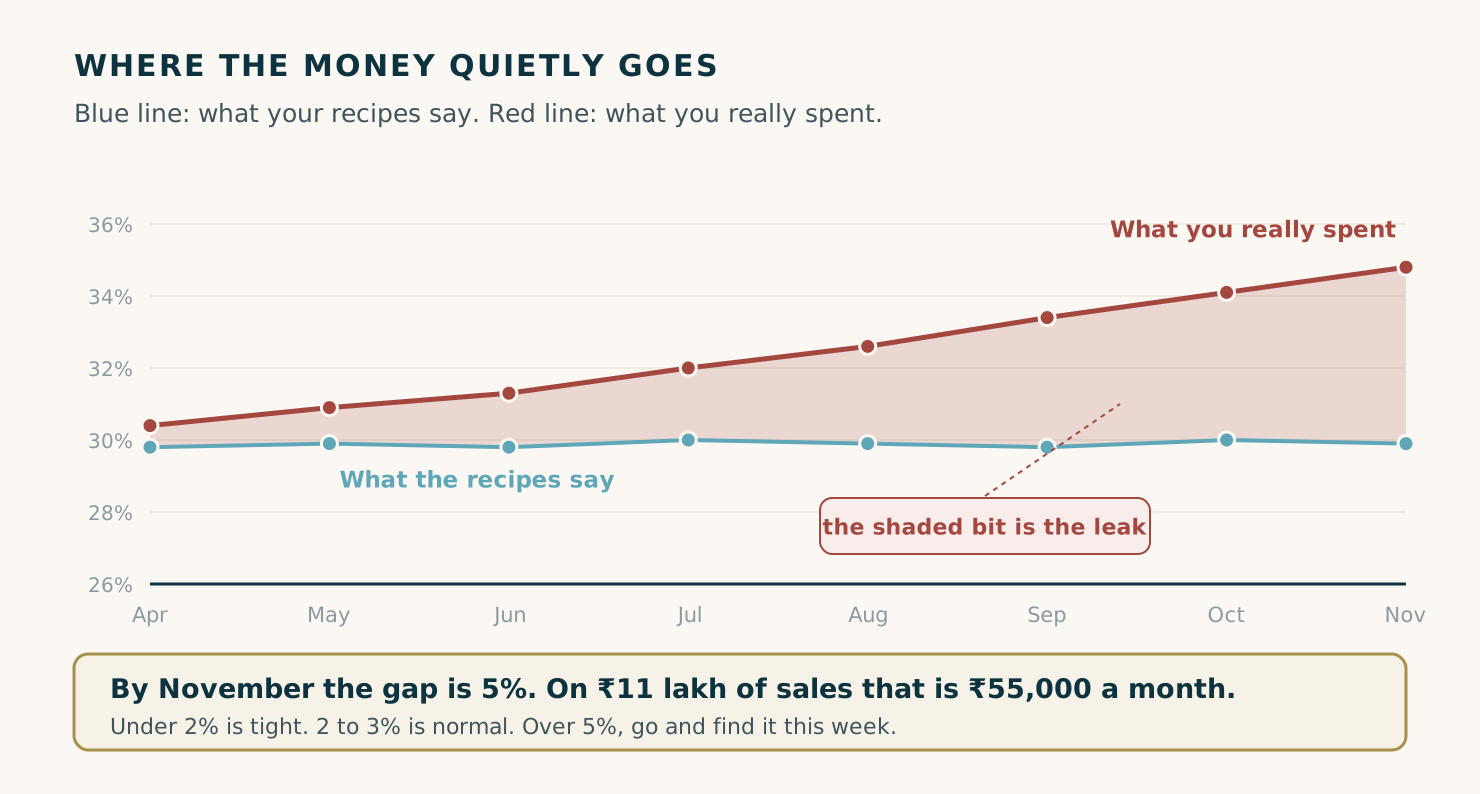
Because every kitchen runs two at once, and the gap is the most useful number you will ever measure.
- Theoretical — what your recipes say you should have spent
- Actual — opening stock + purchases − closing stock
- Variance — the difference, as a share of sales
| Variance | What it means |
|---|---|
| Under 2% | Tight. Well run |
| 2 to 3% | Normal for most kitchens |
| 3 to 5% | There's something to fix |
| Over 5% | Find it this week |
A 5% variance on that same ₹11 lakh is ₹55,000 walking out every month. Never one dramatic thing — over-portioning, trim nobody weighed, spoilage, and recipe cards costed two years ago.
You cannot find it without counting stock. That is the honest reason this number is rare, not the maths.
What is prime cost, and why does it matter more?
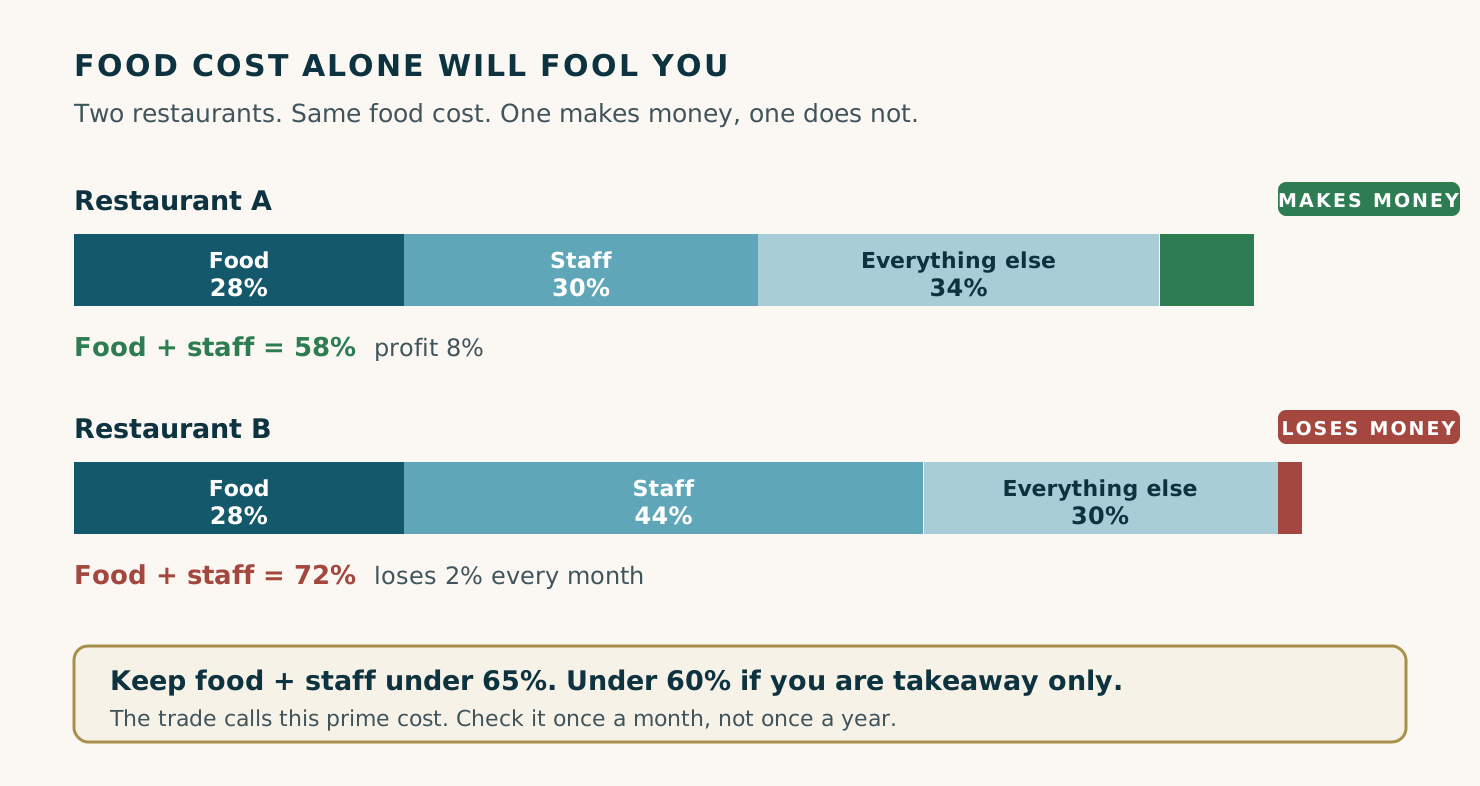
Food cost on its own has fooled a lot of owners. This is the number that actually decides whether the business survives.
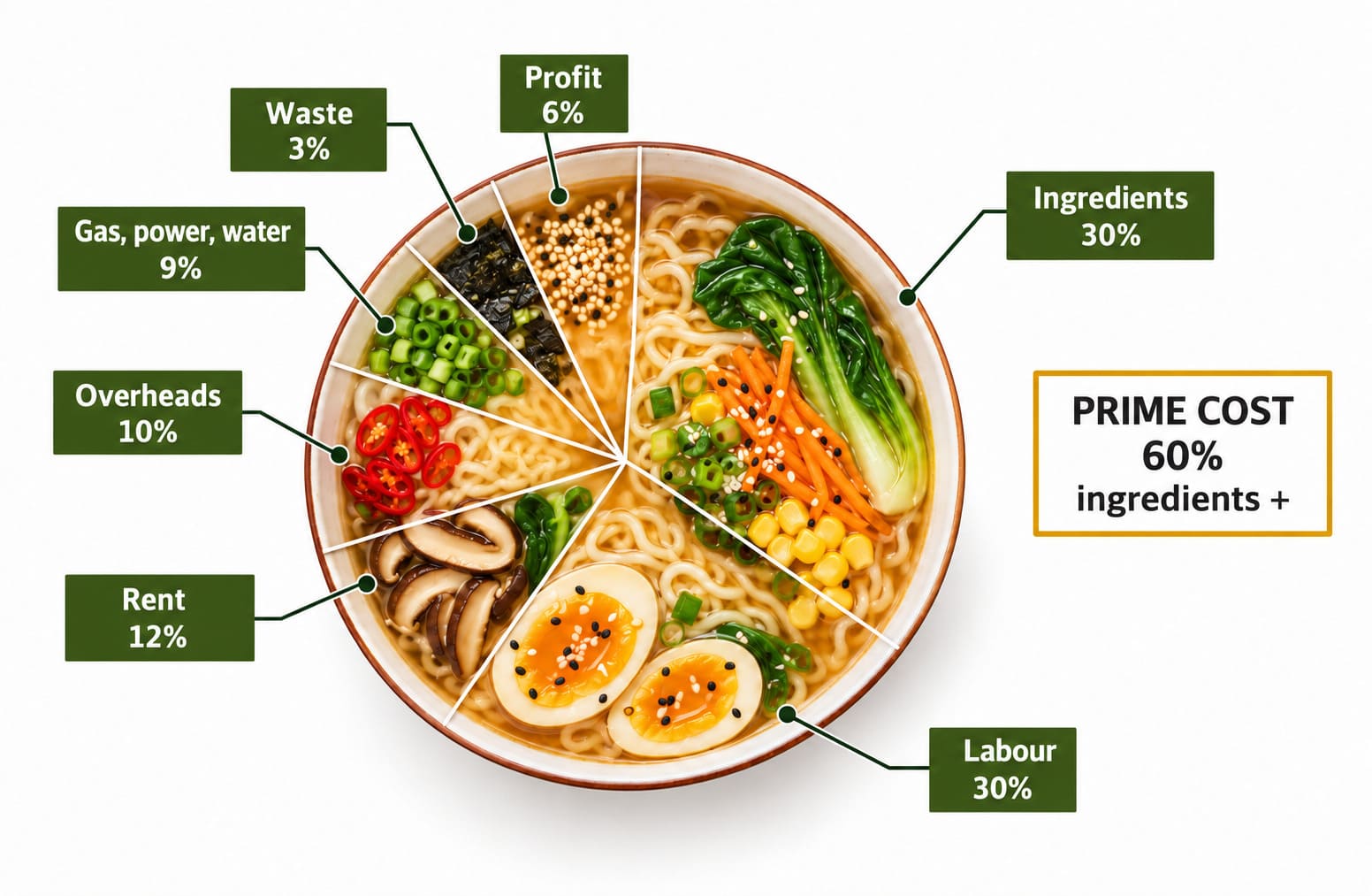
Prime Cost = Food cost + Total labour cost
Labour means everything — kitchen, service, your manager, and PF and ESI if you pay them.
| Type of outlet | Prime cost ceiling |
|---|---|
| QSR and quick service | 60% |
| Full service and fine dining | 65% |
That is the fine dining versus QSR split in reverse — a fine dining restaurant gets the higher ceiling because its lower food cost pays for more staff.
Cross that line and everything else — rent, power, gas, commission, licences, EMIs — comes out of what's left. There usually isn't enough.
A restaurant at 72% prime cost can have a beautiful 28% food cost and still lose money every month. Food cost per dish is a menu decision; prime cost is a survival decision.
FIFTEEN MINUTES, YOUR NUMBERS
Bring your menu and your purchase bills. We'll work out your real food cost and prime cost together — no slide deck.
What does a Swiggy order do to the same dish?
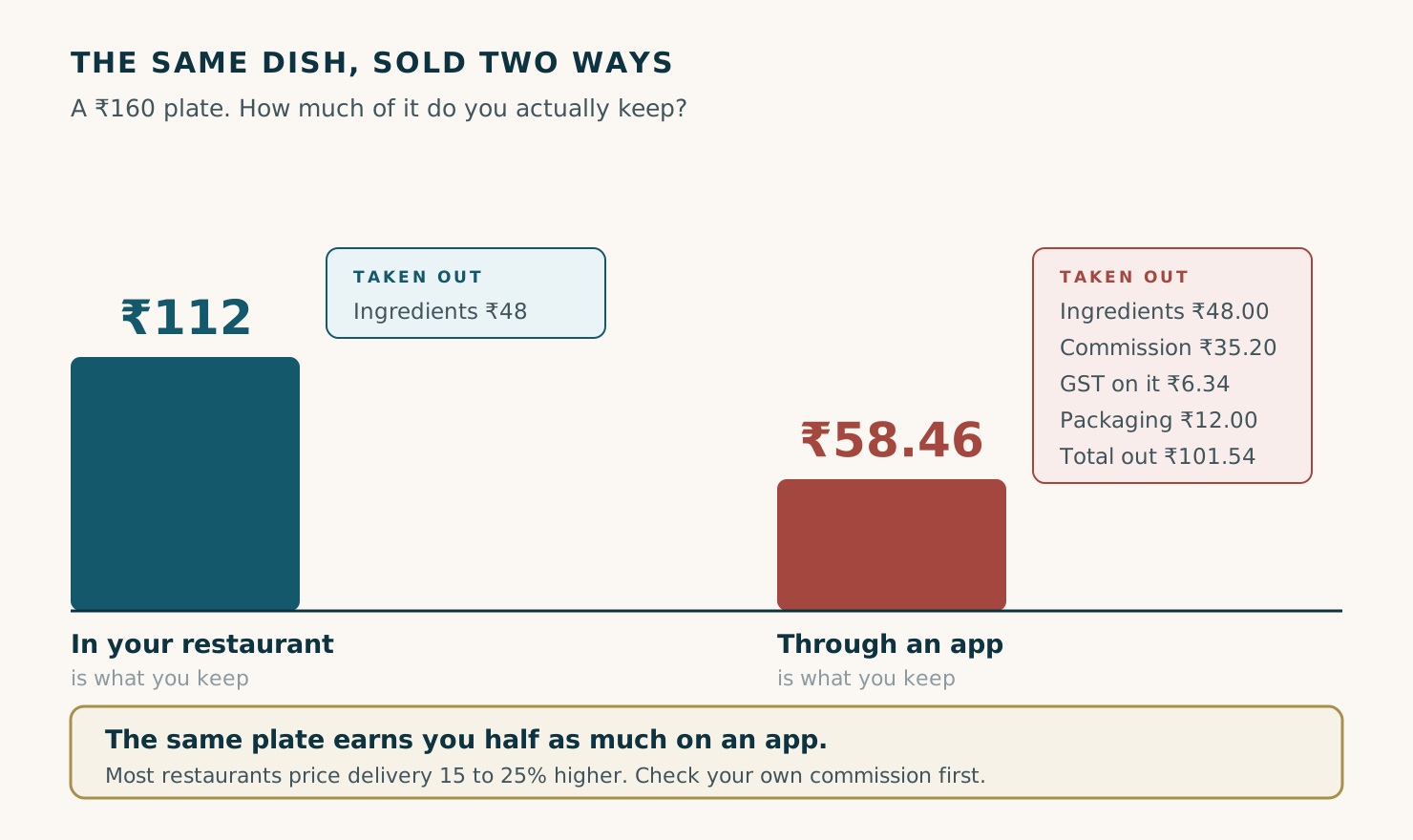
This is the bit almost nobody writes about, and it is quietly costing Indian restaurants a fortune.
That dal makhani at 30% food cost is a healthy dish — on a dine-in bill. Send the identical plate out through an app and the maths falls apart.
| On a ₹160 order | Amount |
|---|---|
| Ingredients | ₹48 |
| Commission at 22% | ₹35.20 |
| GST on that commission, which you cannot claim back | ₹6.34 |
| Packaging | ₹12 |
| Real cost on that order | ₹101.54 |
That is 63% of the order value gone before gas, before salaries, before rent. The dish that works beautifully in your dining room is barely breathing on the app.
The costs that are not on that bill
That ₹101.54 is a plain order with nothing added. Four more lines appear once you actually run on the platforms:
- Ad spend. Promoted listings run another 3 to 5% of order value. Optional on paper, hard to skip in a crowded category
- Discounts you fund yourself. "50% off up to ₹100" is usually paid by the restaurant, not the platform. The biggest hidden cost of the lot
- Payment gateway charges, on top of the commission
- 1% TCS, deducted at source. You adjust it against your GST liability, so it is cash held rather than lost — but not cash you have this month
- A one-time onboarding fee, roughly ₹1,000 to ₹3,000, taken from your early payouts
Put a 4% ad spend on that ₹160 order and 63% becomes 67%. Add a ₹20 discount you funded and it is 80%. At that point you are paying to cook.
Running your own riders swaps commission for salary and fuel — cheaper at volume, worse on a slow Tuesday.
A QSR lives on delivery, so this is its whole business and it has to price for it. A fine dining restaurant sends little through an app, but loses more per order when it does.
Two ways out, neither perfect:
- Price delivery separately. Most restaurants run app prices 15 to 25% above dine-in
- Own the repeat order. A guest who found you on Swiggy and orders directly next time costs you no commission — that is what QR ordering is for
And when you price: the 5% GST you charge is not yours. Cost against the amount before tax, never the figure on the bill.
ORDERS WITHOUT A COMMISSION
Guests scan, see your menu and order directly. Nothing for them to download, and no cut to anyone.
How often should you check your food cost?
Three speeds beat checking nothing or checking everything:
- Per dish, when a rate moves. Top ten sellers only
- Monthly, the whole kitchen. Stock count, actual food cost, variance — this is what catches the leak
- Monthly, prime cost. Two rises in a row means something structural changed
Re-price twice a year, not every time a vegetable gets expensive. Guests forgive a price that moves once; they notice a menu that moves constantly.
The quick reference
| Formula | What it tells you |
|---|---|
| (Ingredient cost ÷ Selling price) × 100 | Food cost % |
| Ingredient cost ÷ Target % | Menu price |
| Selling price − Ingredient cost | Contribution per dish |
| Opening stock + Purchases − Closing stock | Actual food cost |
| Actual − Theoretical, over sales | Your leak |
| Food cost + Labour cost | Prime cost |
Print this. Six lines is the whole of restaurant costing.
What CurryIQ is, and how it helps
CurryIQ is restaurant software that runs in your browser — nothing to install, no machine to buy.
Being straight with you: it does not print a food cost percentage. It holds every number this post asked you to find, so working them out stops being a Sunday night with a calculator.
Recipe-level ingredient tracking. Build each dish once. Stock comes off automatically on every order sold, so "what you consumed" is counted, not guessed.
Waste tracking and cost analysis. The gap between what the recipe says went out and what actually left is the variance this post is about.
Item performance. Every dish by quantity and by revenue: the denominator in every formula above.
All of that sits in inventory management, alongside GST billing that puts CGST and SGST on separate lines.
One thing before you sign up: recipe-based stock deduction sits on a higher plan than the entry one — it is what makes food cost work without manual entry, so check which plan you need.
TRY IT ON ONE DISH
Load a single recipe and your menu price. Two minutes, and you'll see the number you've been guessing.
Frequently asked questions
What is the food cost formula in a restaurant?
Divide what the ingredients really cost — the usable quantity, not the purchase rate — by the menu price before GST, then multiply by 100. A ₹48 plate at ₹160: 48 ÷ 160 × 100 = 30%.
What is a good food cost percentage in India?
Between 25 and 35% for most outlets. QSR and cloud kitchens sit around 28 to 32%, fine dining 30 to 35%, cafes lower because beverages carry them.
What is the difference between food cost and prime cost?
Food cost is ingredients only; prime cost adds labour. Keep it under 60% in quick service, 65% in full service.
How do I calculate monthly food cost?
Opening stock plus purchases minus closing stock gives what you consumed. Divide that by the month's food sales and multiply by 100.
Why is my actual food cost higher than my recipe cost?
Yield loss, over-portioning, waste, spoilage, and recipe cards costed at old prices. The gap between the two numbers is where your money goes.
Why is fine dining food cost lower than QSR?
The price rises faster than the recipe. Dhaba to fine dining, ingredients go up about 75% but the price goes up about 190%. The room and the service take the difference.
Does a lower food cost mean more profit?
No. A dhaba at 36% can out-earn a fine dining restaurant at 22% — almost no rent, two cooks, six table turns a night. Prime cost tells you more.
Should I charge more on Swiggy and Zomato than for dine-in?
Most do, by 15 to 25%. Commission, the non-claimable GST on it and packaging take roughly a third of the order before you cook.
BUILT IN INDIA, FOR INDIAN RESTAURANTS
GST billing, stock counting and dish-level reporting in one browser tab. Free onboarding, nothing to install, cancel anytime.
Keep reading
Ready to try CurryIQ?
Start free. No credit card required. Setup in 10 minutes.